How to choose the right needle for any project
Using the right needle can make a surprising difference in your embroidery. The wrong one can fray your thread quicker, leave visible holes in the fabric, or simply make every stitch harder than it needs to be. The good news is that choosing a needle is straightforward once you know what to look for.
This guide walks you through the four things that matter most: needle type, needle size, number of floss strands, and your fabric. So you can pick the perfect needle for any project.
Needle sizing isn't perfectly standardized across brands. A size 7 from DMC and a size 7 from John James or Tulip are close, but not identical: shaft thickness and eye size can vary slightly. This rarely causes problems, but if you switch brands and something feels off, test before assuming you need a different size. When in doubt, the "slight pop, no resistance" rule is more reliable than the number alone.
Needle anatomy 101
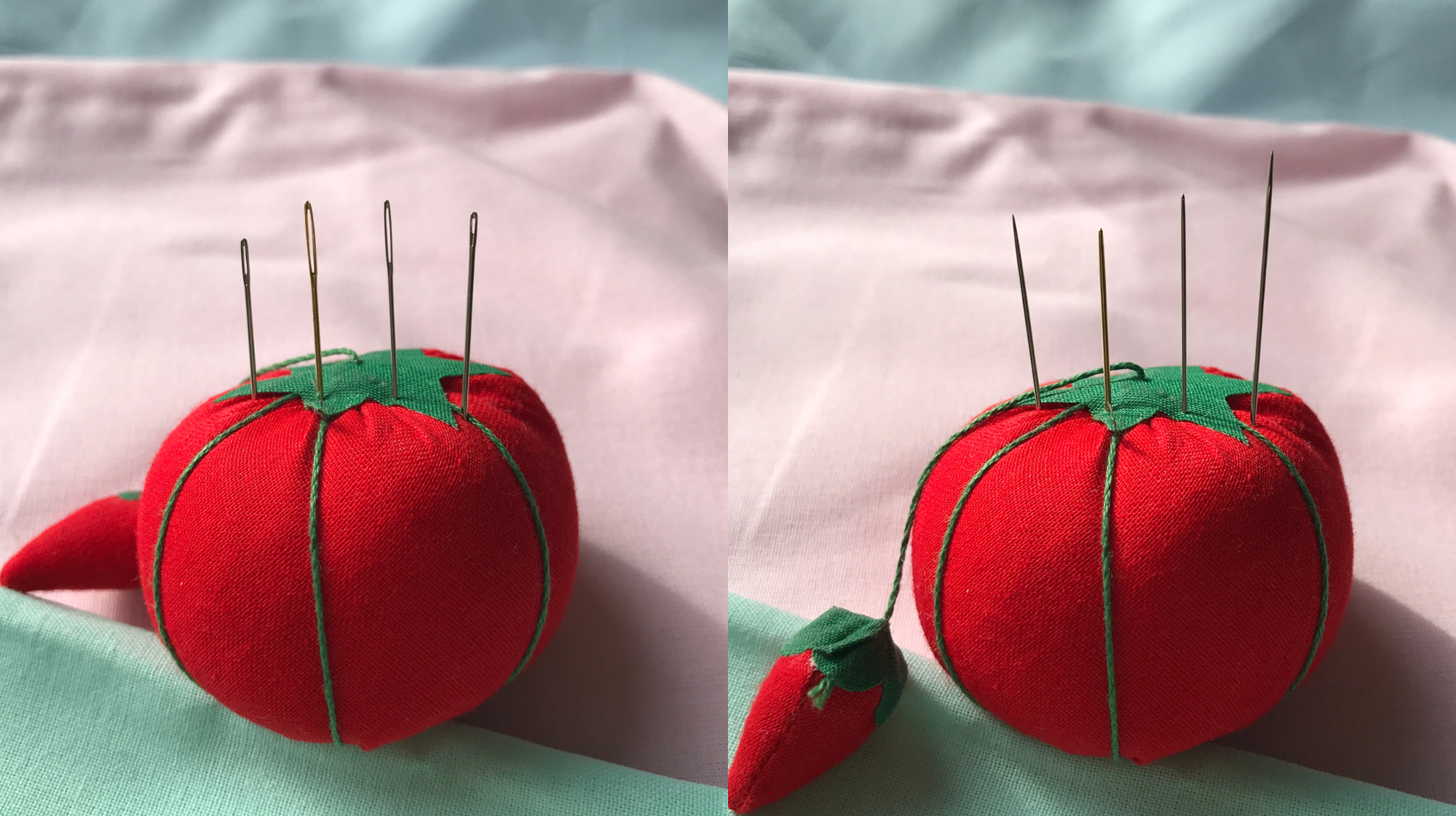
Every hand-sewing needle has three parts that affect how it works:
Point (tip). Sharp points pierce tightly woven fabrics like linen and cotton. Blunt (rounded) points slip between the threads of open-weave fabrics like Aida without snagging them.
Eye. The opening through which the thread passes. A larger eye accommodates thicker thread or more strands, while a smaller eye keeps the needle slim. The eye should be just large enough to hold your thread without it slipping out.
Shaft. The thickness of the needle body. The shaft creates the hole your thread must pass through, so it should be roughly the same diameter as the thread you are using. Too thin and the thread will drag; too thick and you will leave visible holes.
One thing that trips up beginners: embroidery needle sizes are numbered in reverse. The higher the number, the thinner and shorter the needle. A size 3 needle is large and thick, while a size 10 is fine and delicate.
Types of needles
There are several needle families, each designed for a different job. Here are the three types you will use most often in hand embroidery. For a deeper look at each type with photos, see my Types of Needles for Hand Embroidery article.
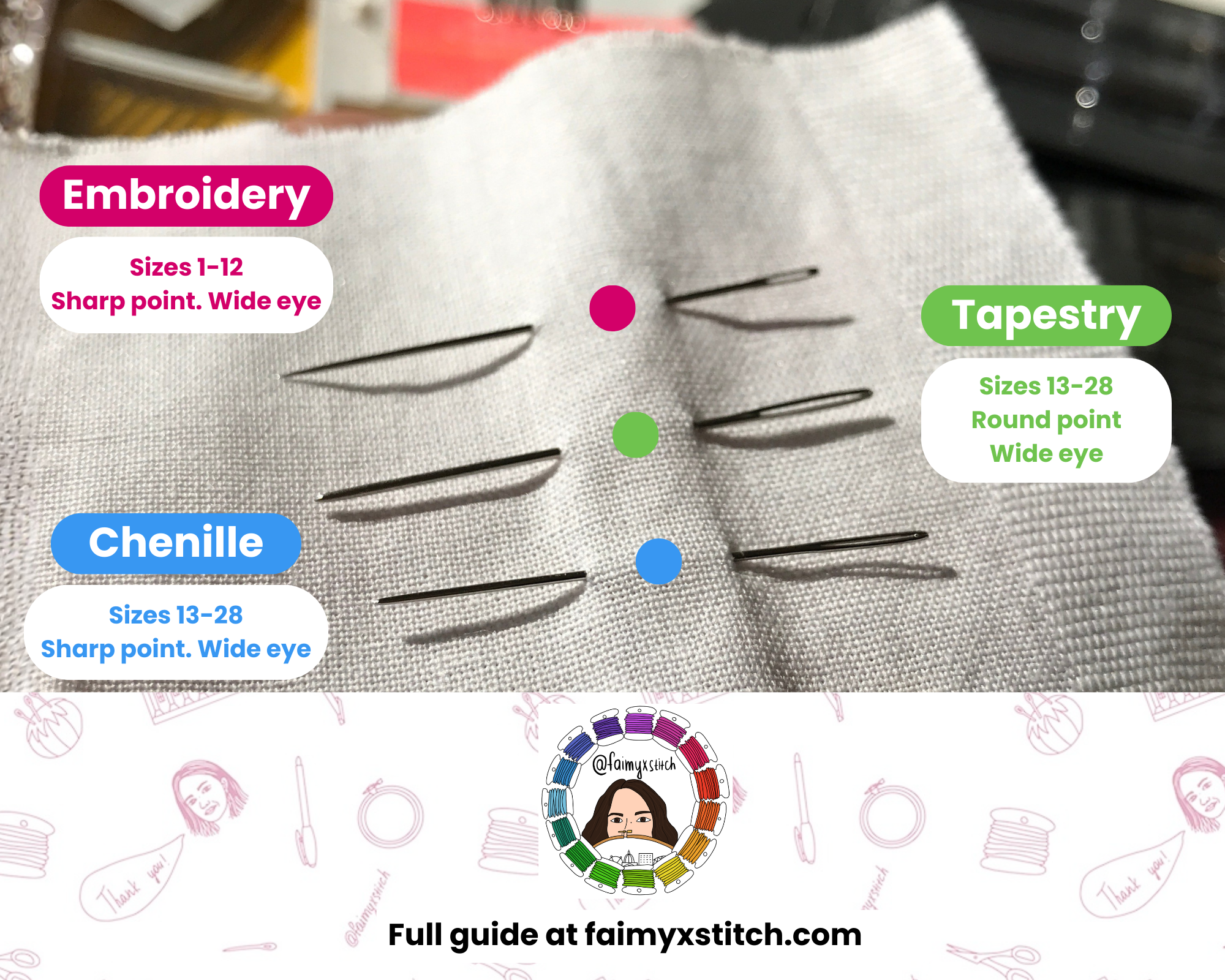
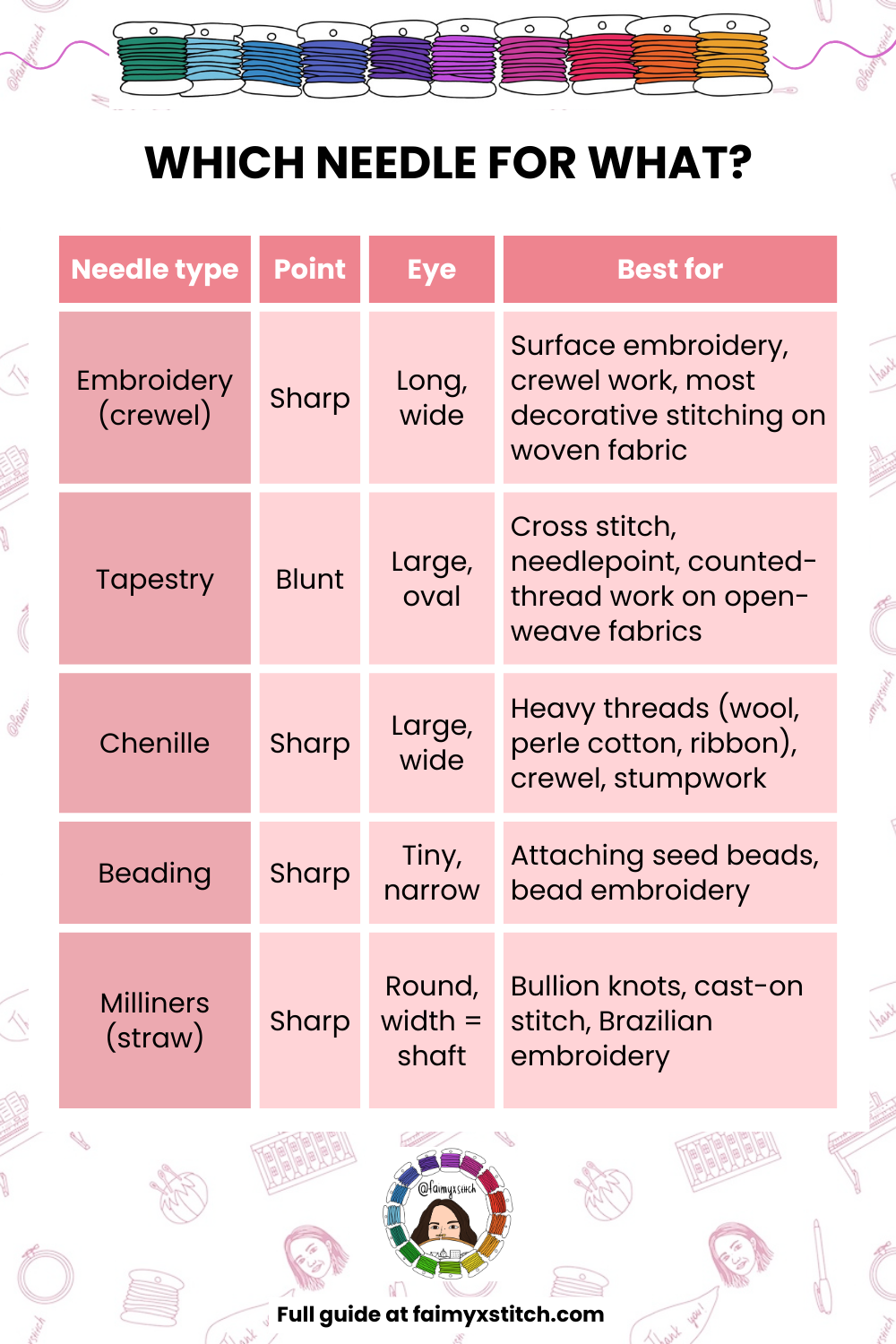
- Embroidery (Crewel) Needles. The most versatile needle for hand embroidery. They have a sharp point that pierces fabric easily and a long, wide eye for threading multiple strands of floss. Use them for surface embroidery, crewel work, and most decorative stitching. Sizes: 1 to 12 (from biggest to smallest)
- Tapestry Needles. These have a blunt, rounded tip and a large oval eye. The blunt point slides through the holes in open-weave fabrics without piercing the threads, making them the standard choice for cross stitch, needlepoint, and counted-thread work. Sizes: 13 to 28 (from smallest to biggest)
- Chenille Needles. Similar to embroidery needles (sharp point, large eye) but slightly shorter and thicker. They are ideal for working with heavier threads like wool, perle cotton, or ribbon. Great for crewel embroidery and projects with chunkier materials. Sizes: 13 to 28 (from smallest to biggest)
Needle sizes explained
Embroidery needles are available in sizes 1 through 12. Remember the reverse numbering rule:
• Size 1 - the largest: thick shaft, big eye, longest length
• Size 12 - the smallest: thin shaft, small eye, shortest length. In some brands, sizes go up to 10 only.
The basic principle is simple: match the needle size to the amount and thickness of thread you are using. Thicker thread (or more strands) needs a larger needle; thinner thread needs a smaller one.
There is no single "correct" size for every situation; the charts below are guidelines. If a needle feels comfortable to thread, passes through the fabric with a slight pop but no force, and leaves no visible holes, you have found the right size.
Needle size guide for stranded floss (Mouliné)
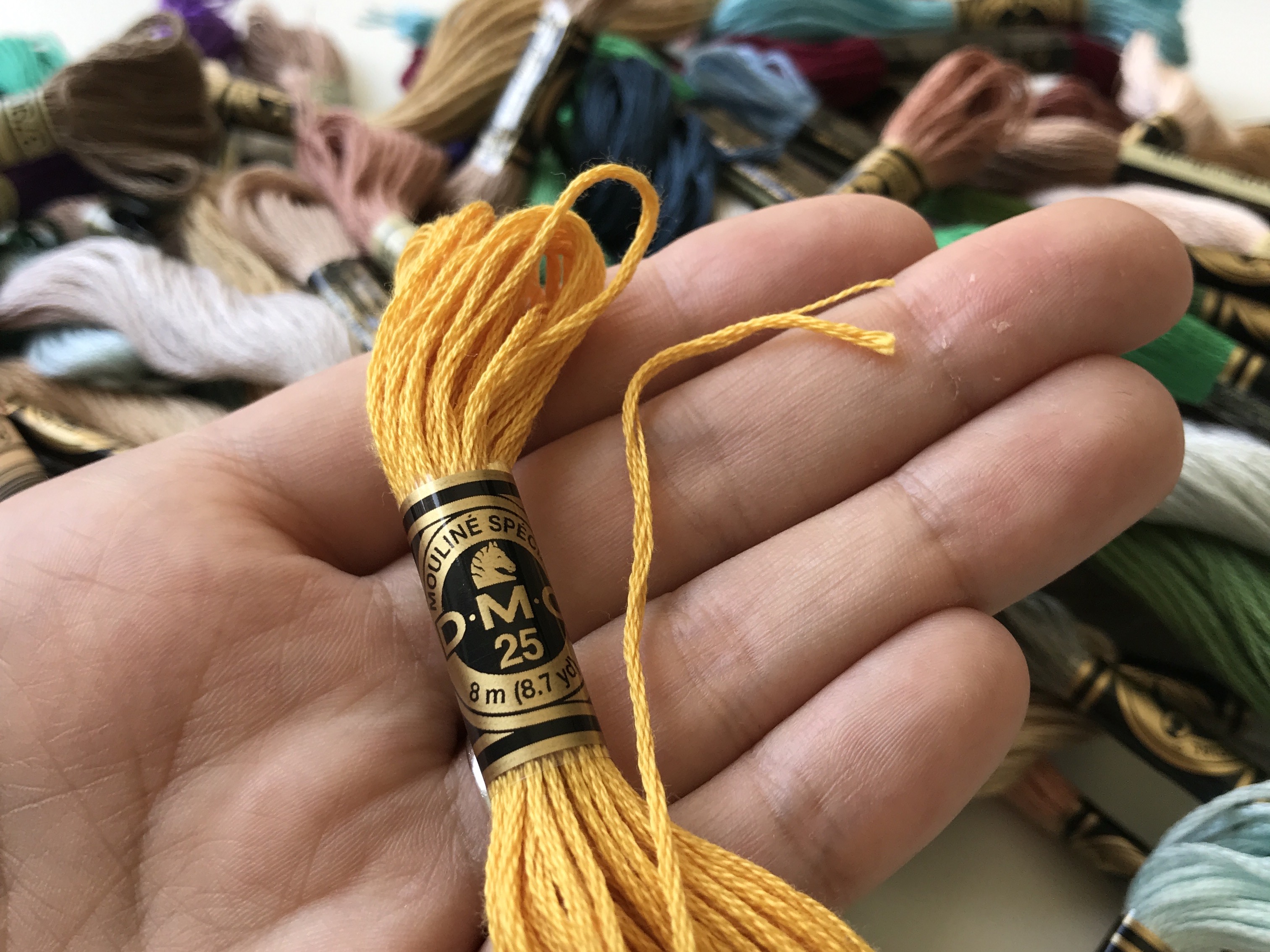
Six-strand embroidery mouliné floss (like DMC or Anchor) is the most common thread for hand embroidery. You separate it into the number of strands your project calls for. My patterns always include the info about the number of strands to use.
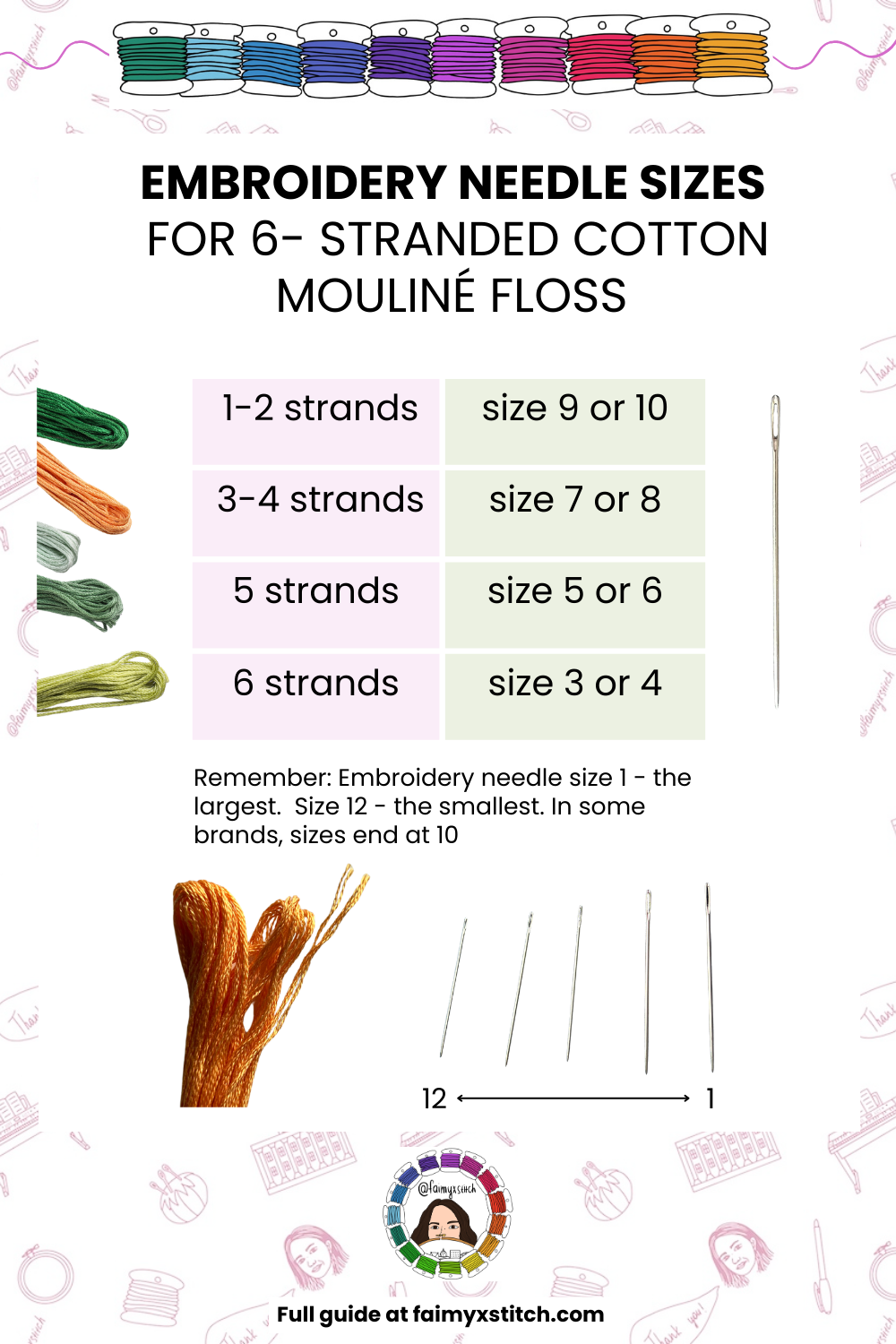
Embroidery needle size vs 6-stranded floss. Quick guidelines:
| Number of strands | Needle size |
|---|---|
| 1-2 strands | size 9 or 10 |
| 3-4 strands | size 7 or 8 |
| 5 strands | size 5 or 6 |
| full 6 strands | size 3 or 4 |
If you mostly stitch with 2 strands, a size 9 embroidery needle is a great everyday choice. If you like working with 3 strands for a bolder look, try a size 7.
Overall, a pack of embroidery needles from sizes 3 up to 9 will cover all your needs.
Needle size guide for Perle cotton
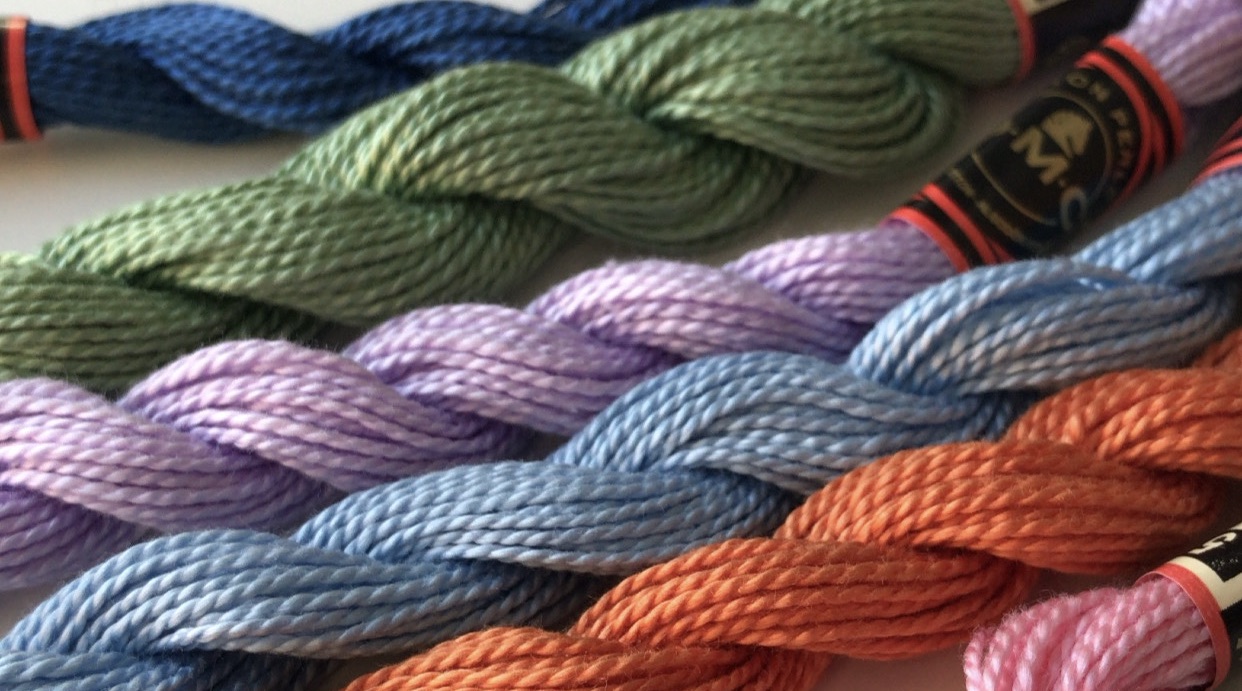
Perle (pearl) cotton is a twisted, non-divisible thread. Its own sizing also runs in reverse. A smaller number means a thicker thread. Because perle cotton is thicker than individual strands of floss, a chenille needle sometimes works better than an embroidery needle: the wider eye accommodates the twisted thread more easily.
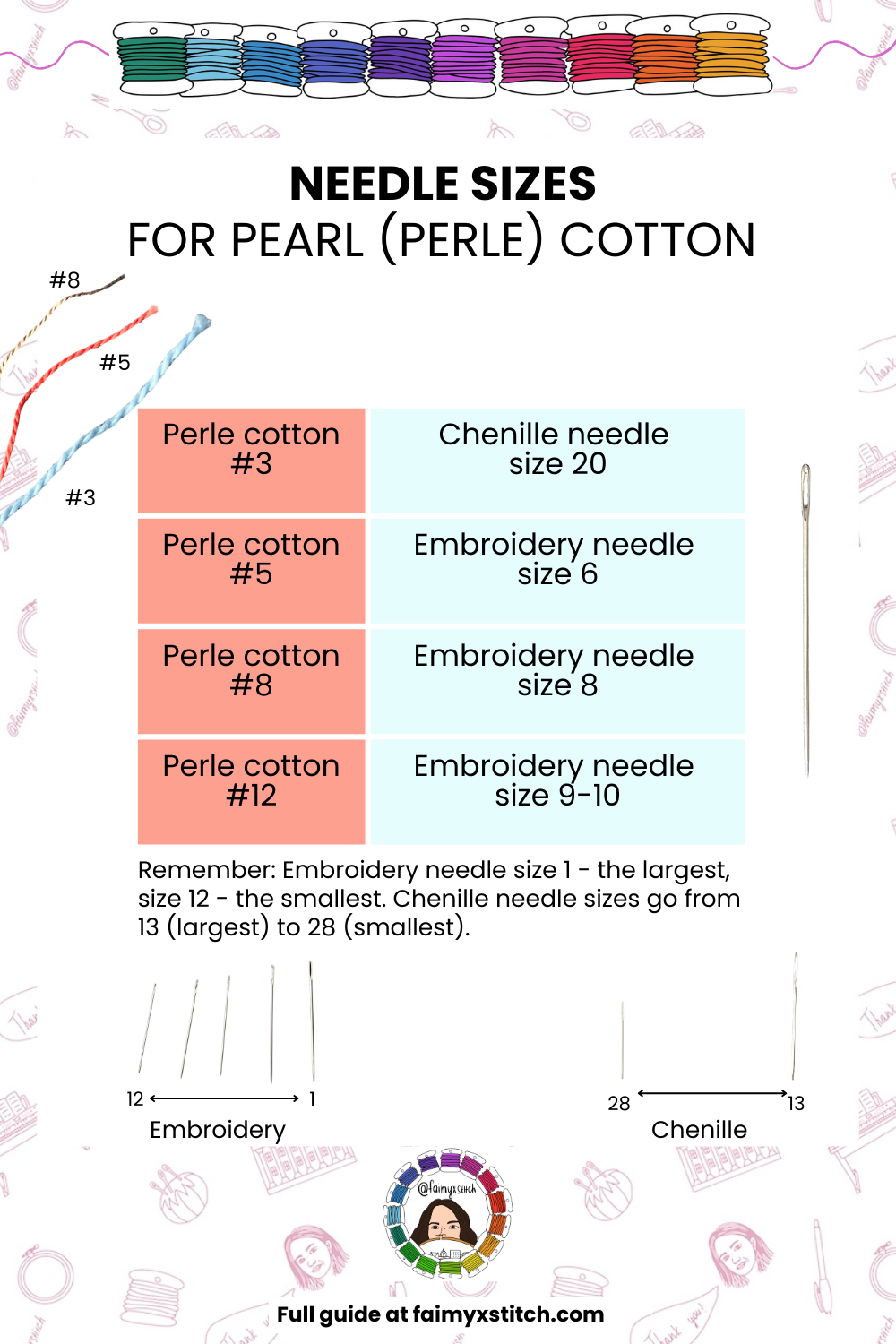
The size reference:
| Perle cotton thickness | Needle size |
|---|---|
| Perle #3 (thickest) | Chenille needle size 20 |
| Perle #5 | Embroidery needle size 6 |
| Perle #8 | Embroidery needle size 8 |
| Perle #12 (thinnest) | Embroidery needle size 9 or 10 |
In terms of the thickness of threads and comparison to the mouline strands, you can use this reference:
The thread thickness reference:
| 6-stranded cotton floss | Perle cotton |
|---|---|
| 8 strands of mouline | #3 Perle cotton |
| 5 strands of mouline | #5 Perle cotton |
| 3 strands of mouline | #8 Perle cotton |
| 2 strands of mouline | #12 Perle cotton |
They won't look alike, but the thickness will be close.
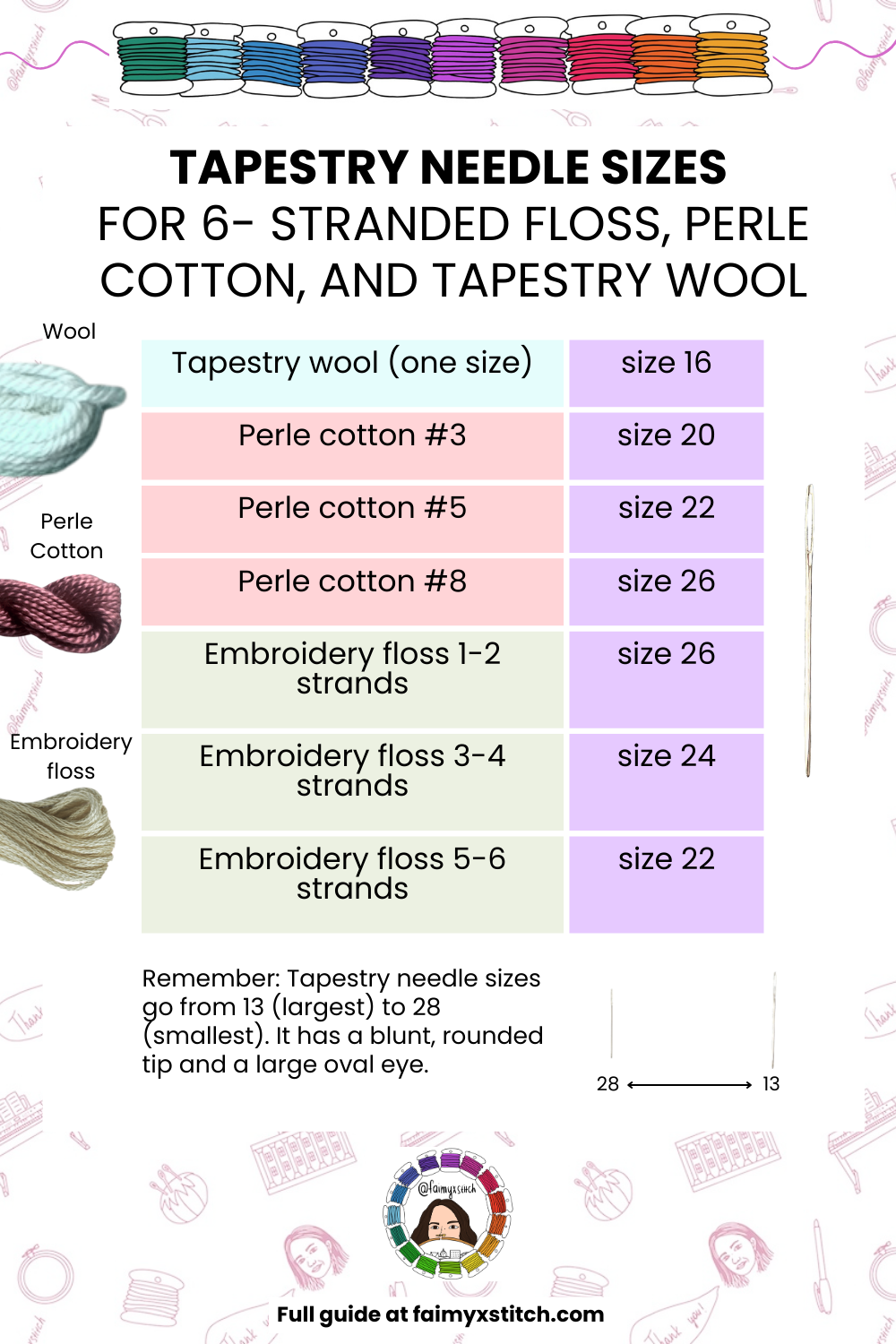
Tapestry needle size guide
For this one, I added several types of threads. Because you can do a very wide range of techniques on a counted fabric. Not just cross-stitching, but also Bargello, Assisi, Blackwork, and so on.
The reference table for the tapestry needle:
| Type and size of thread | Tapestry needle size |
|---|---|
| Tapestry wool (one size) | 16 |
| Pearl Cotton #3 | 20 |
| Pearl Cotton #5 | 22 |
| Pearl Cotton #8 | 26 |
| Embroidery floss 1-2 strands | 26 |
| Embroidery floss 3-4 strands | 24 |
| Embroidery floss 5-6 strands | 22 |
Matching needle to fabric
Your fabric matters just as much as your thread when choosing a needle.
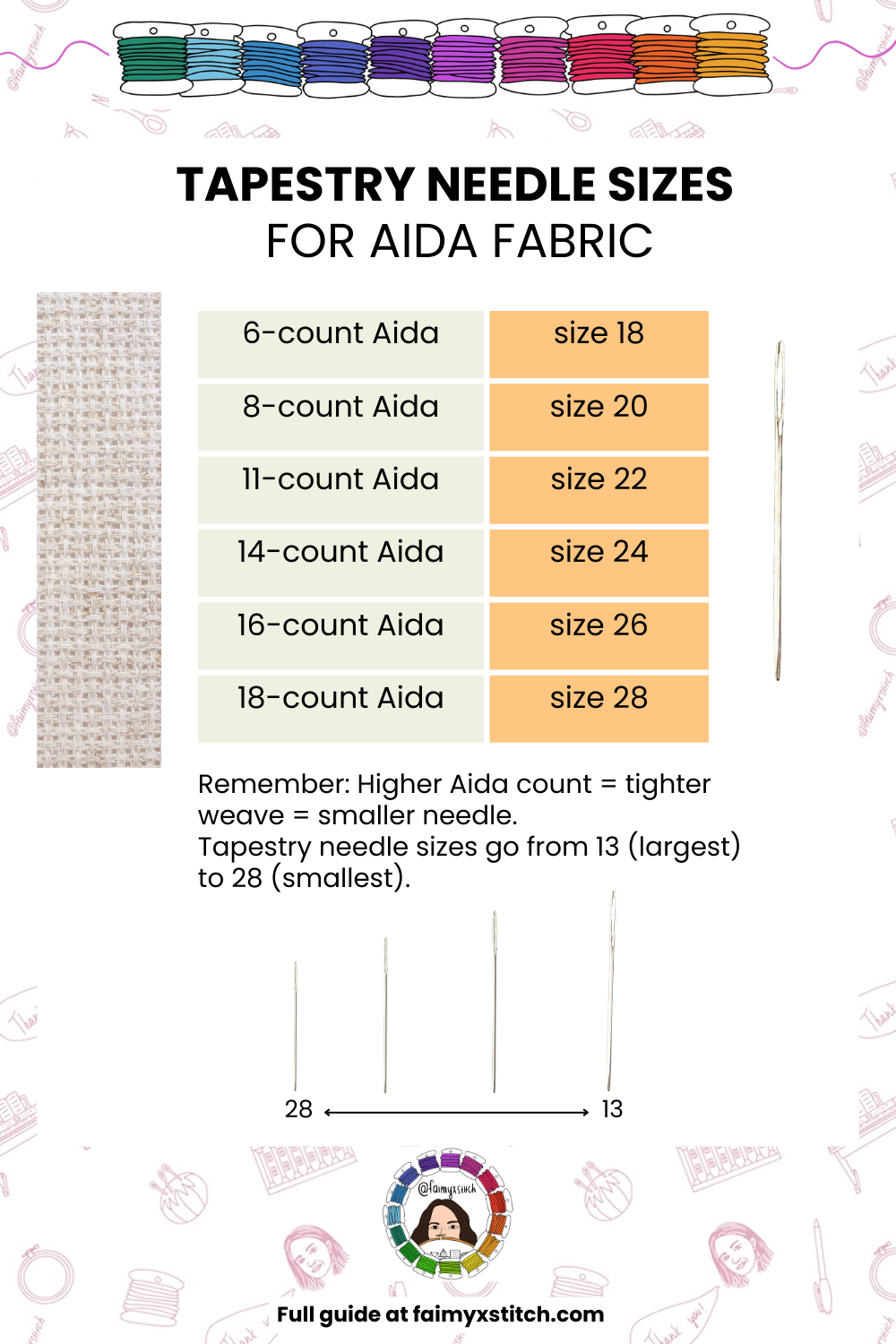
Aida fabric (cross stitch): Aida is woven with visible holes, so use a blunt tapestry needle. The fabric count tells you how many stitches fit per inch: higher counts mean tighter weave and require thinner needles.
Size reference:
| Aida count | Tapestry needle size |
|---|---|
| 6-count Aida | 18 |
| 8-count Aida | 20 |
| 11-count Aida | 22 |
| 14-count Aida (most popular) | 24 |
| 16-count Aida | 26 |
| 18-count Aida | 28 |
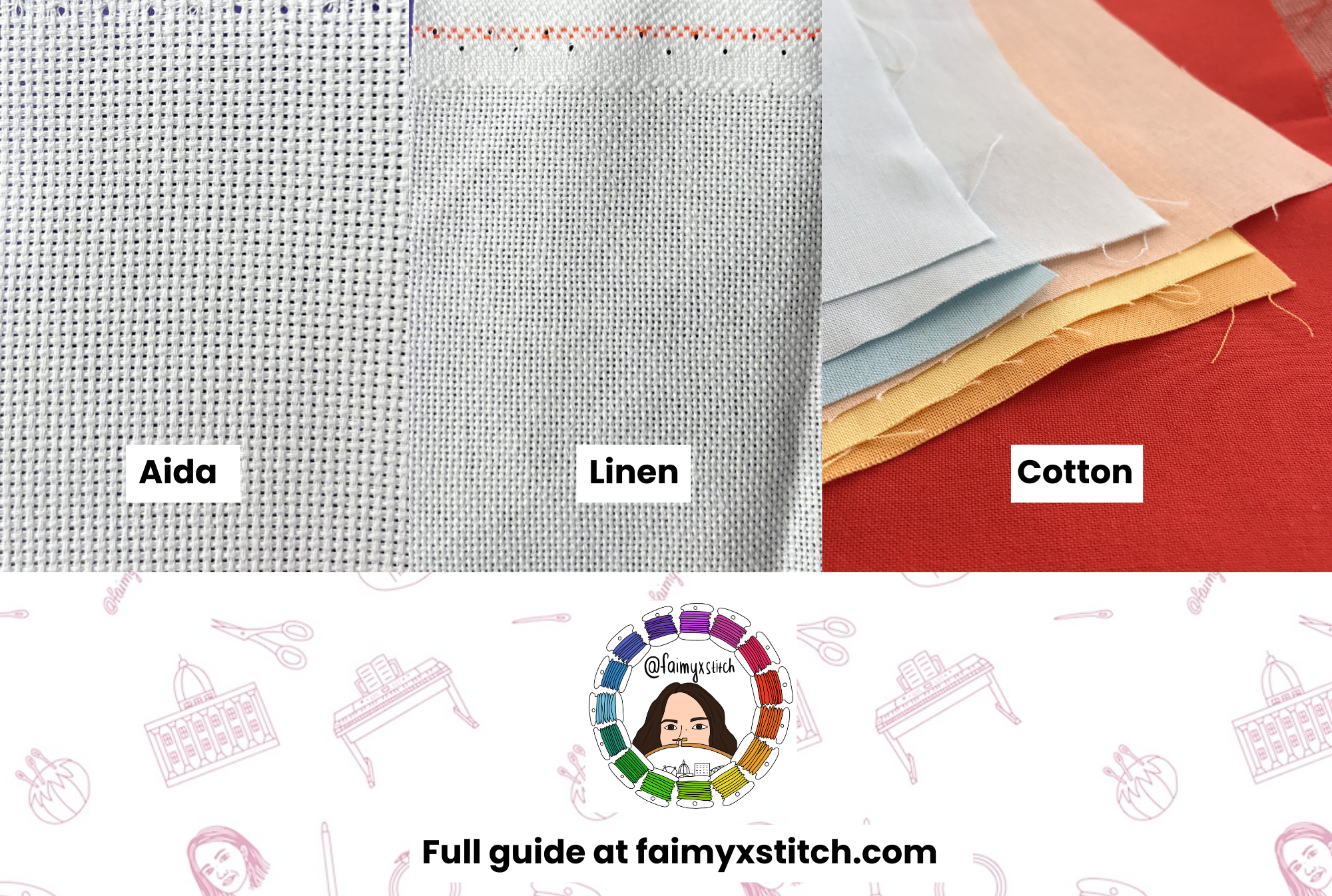
Linen and evenweave: These fabrics have a tighter weave than Aida. A sharp embroidery needle usually works best because it can pierce between the threads. For counted work on evenweave, some stitchers prefer a small tapestry needle (size 26–28) that slips between the fabric threads without splitting them. It's up to you to give it a go and see which way works best.
Plain cotton or closely woven fabric: Use a sharp embroidery needle. The tighter the weave, the finer the needle should be, so it can pass through without distorting the threads. That also means using less strands.
General rule: the needle should pass through the fabric with a slight pop but no resistance. If you have to force it, try a thinner needle. If the hole looks visible around your stitch, try a thinner one too.
Quick guide: 4 steps to pick your needle
- 1Determine your techniqueAre you doing surface embroidery, cross stitch, or needlepoint? Surface embroidery uses sharp needles; cross stitch and needlepoint use blunt tapestry needles.
- 2Choose the needle typePick embroidery (crewel) needles for most hand embroidery, tapestry needles for cross stitch and counted work, chenille needles for thick threads, or beading needles for adding beads.
- 3Match the size to your threadUse a larger needle (lower number) for thicker thread or more strands, and a smaller needle (higher number) for fewer strands. For example, 1-2 strands of floss work best with a size 9-10 embroidery needle.
- 4Adjust for your fabricFiner fabric weaves need thinner needles. For Aida cross-stitch fabric, match the fabric count to the tapestry needle size (14-count Aida uses a size 24 needle). Test by pulling through: you should feel a slight pop but no resistance.
What needle for which project
What needle should I use for...?
Surface embroidery
(satin stitch, stem stitch, lazy daisy, backstitch on cotton or linen)
Embroidery/crewel needle, sizes 7–9 for 2–3 strands, sizes 3–5 for heavier thread. A sharp point is essential for piercing the fabric easily.
Cross stitch
Tapestry needle, blunt point. Size 24 for 14-count Aida (the most common), size 26 for 16–18 count. Never use a sharp needle on Aida — it splits the fabric threads instead of passing through the holes.
Blackwork
Tapestry needle on evenweave or Aida (sizes 24–26), embroidery needle on plain linen (size 8–9 with 1–2 strands). The choice also depends on your fabric, not the technique itself.
Thread painting
Embroidery needle, sizes 9–10. Thread painting typically uses 1–2 strands for fine blending, so you need a small, fine needle that creates almost zero disturbance in the fabric. Precision matters more here than in most other techniques.
Bargello
Tapestry needle on canvas (sizes 18–22, depending on canvas count). Bargello is always worked on needlepoint canvas, so the blunt point is non-negotiable. You're passing through holes, not piercing threads.
Crewel embroidery
Chenille needle (sizes 20–22) or embroidery needle (sizes 3–5), depending on your wool thickness. Chenille needles have a wider eye that handles the twist of wool yarn without fraying it.
Stumpwork
Varies by element: embroidery needle for surface stitching, chenille for padding threads and ribbon, milliners for cast-on and bullion stitches. Stumpwork is the one technique where you'll likely need three needle types in a single project.
Sashiko and visible mending
Sashiko needle (long shaft, large eye) for traditional running stitch on heavy fabric. The length lets you load several stitches onto the needle at once, which is what creates the even rhythm.
Needlepoint
Tapestry needle, size matched to canvas count (same logic as Aida — higher count, higher size number).
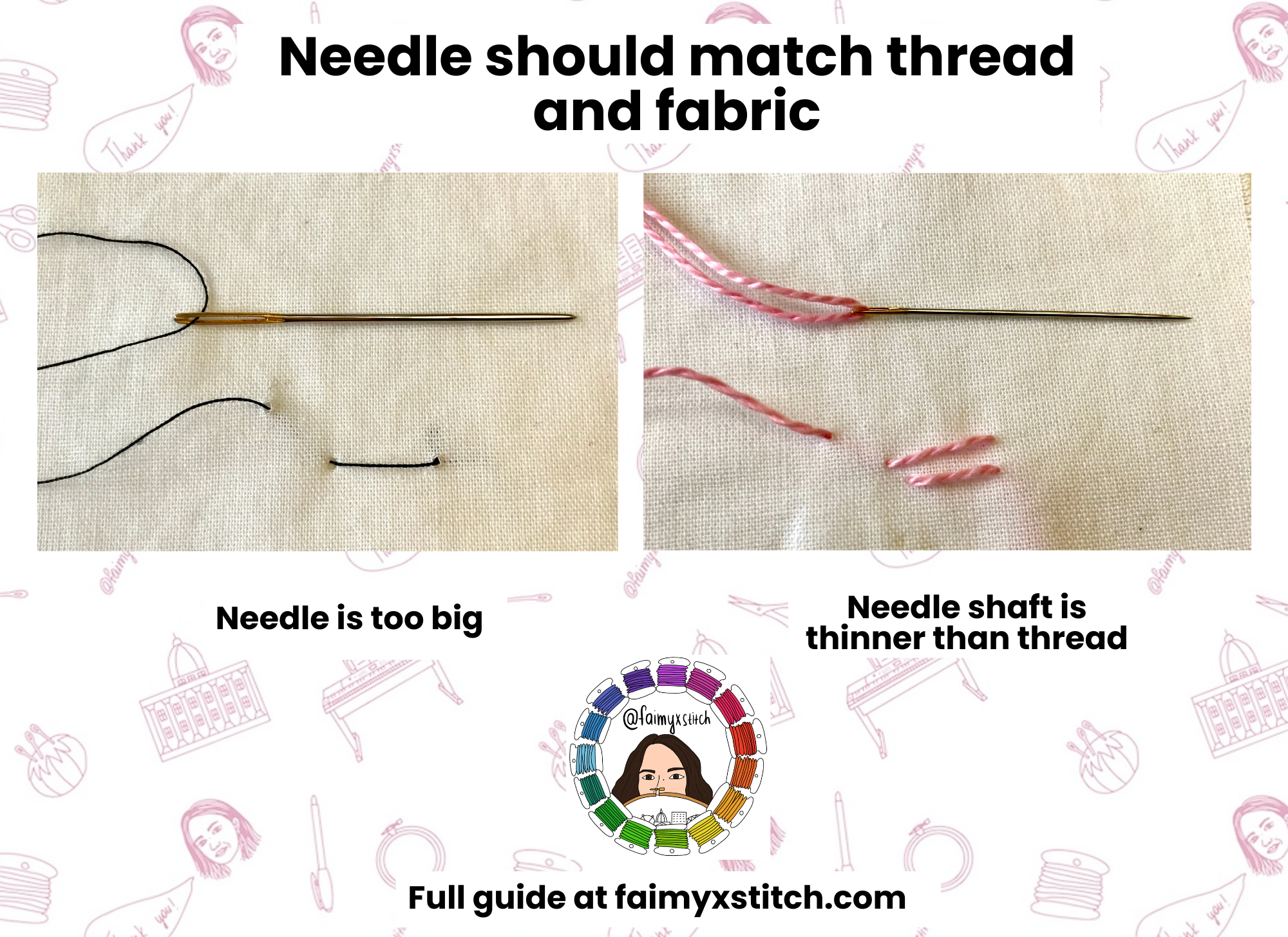
Signs you're using the wrong needle
If something feels off while you are stitching, the needle is often the reason. Here is how to tell:
Needle too small:
• The needle is hard to thread, and the strands keep catching on the eye, trimming the end doesn't help
• Thread frays, fuzzes, or breaks during stitching
• Pulling the needle through the fabric requires noticeable force
• The fabric tears or distorts around your stitches
Needle too big:
• Visible holes remain in the fabric around your stitches
• The thread slips out of the eye while you stitch
• Stitches look uneven, or you struggle to place them close together
• It is hard to fill areas densely; the fabric shows through
If you notice any of these signs, try moving one size up or down. It can make a big difference.
Needle care tips
A few simple habits will keep your needles in great shape:
• Remove the needle from your fabric when you are not stitching. A needle left in fabric for days can leave a permanent hole or, over time, develop rust spots. Have you seen cute needle miners? They are also good for your needle "health"
• Store your needle stash in a felt needle case or magnetic holder. This protects the point and keeps them organized. If you are looking for a fun project, try making your own Felt Needle Book!
• Replace bent or dull needles. A damaged needle drags through fabric and can snag your thread. Needles are not meant to last forever; swap them out regularly.
• Keep a small selection of sizes on hand. Having sizes 3-9 in embroidery needles, plus sizes 24 and 26 in tapestry needles, covers the vast majority of projects.
Needle material: does it matter?
Most hand-sewing needles are steel, but the coating varies, and it affects how the needle feels in use.
Nickel-plated steel is the standard. It's smooth, durable, and works well for most embroidery. Most needles you'll find in general craft stores are nickel-plated.
Gold-plated needles (often marketed as "gold tapestry" or "gold embroidery") glide through fabric more smoothly, which matters if you're working on a tightly woven fabric or doing a lot of stitching in one session. They're also a good option if you have a nickel sensitivity. Some stitchers find their fingers react to prolonged contact with nickel-plated needles.
Black nickel needles are easier to see against light fabrics, which is sometimes helpful for threading and placement.
The material doesn't affect the stitch itself. A size 7 is a size 7 regardless of coating. But if your needle feels like it's dragging or your fingertips are reacting, switching to gold-plated is worth trying.
Frequently asked questions
- What size needle should I use for 2 strands of embroidery floss?
- For 1-2 strands of six-strand embroidery floss, use a size 9 or 10 embroidery (crewel) needle. The small eye holds the thread securely, and the thin shaft creates a clean hole that the thread fills nicely.
- What is the difference between a tapestry needle and an embroidery needle?
- The main difference is the tip. Tapestry needles have a blunt, rounded point that slides between threads on open-weave fabrics like Aida without piercing them, standard for cross stitch and counted work. Embroidery needles have a sharp point that pierces tightly woven fabric like cotton or linen, making them the go-to for surface embroidery.
- What needle should I use for cross stitch?
- Use a blunt tapestry needle for cross stitch. The most common combination is a size 24 tapestry needle with 14-count Aida fabric. For finer fabric (16-count or 18-count), move to a size 26 or 28 tapestry needle.
- Do I need a sharp or blunt needle for embroidery?
- It depends on your fabric. Use a sharp embroidery needle for tightly woven fabrics like cotton, linen, and muslin. The sharp point pierces the fabric cleanly. Use a blunt tapestry needle for open-weave fabrics like Aida, where visible holes already exist, and you want the needle to slip between threads without splitting them.
- How do I know if my needle is too big or too small?
- A needle that's too small is hard to thread, frays the thread, and catches when you pull through. A needle that's too big leaves visible holes in the fabric and lets the thread slip out of the eye. If either happens, move one size up or down and test again.
Summary
Choosing the right needle comes down to three decisions: pick the type that matches your technique (sharp for embroidery, blunt for cross stitch), pick the size that matches your thread (shaft thickness = thread thickness), and adjust for your fabric (tight/loose weave, counted). Once you get the hang of it, it becomes automatic.
If you are just getting to know the materials, my Supplies for Hand Embroidery article covers everything else you need.
Completely new to embroidery? I send a free beginner stitch-along pattern with step-by-step videos to everyone who joins my mailing list. It's a gentle way to put all of this into practice!